

Why Sitting Is Bad for Your Lower Back!
Do you spend most of your day sitting?
Whether you’re working at a desk, driving, or relaxing on the couch, sitting for hours at a time may be one of the biggest contributors to lower back pain.
The problem isn’t that sitting is inherently bad—it’s that we sit for far too long without moving.
I’m Dr. Garst with TWCC in Mesa and Gilbert AZ, In this video, I’ll explain why prolonged sitting stresses your lower back and what you can do to protect your spine.
Your spine is designed for movement. Walking, bending, reaching, and changing positions help keep your joints, muscles, and spinal discs healthy. A great analogy is like a sponge. When the sponge soaks up water its supple, pliable, softer, changes shape with relative ease. But after the dishes are done and the sponge is left out of the water for an extended period of time, it becomes rigid, hard, crusty, and loses a lot of the properties it had when it was wet. Your body, specifically your spine, is very similar when it comes to movement.
When you sit for long periods, your hips stay flexed, your core muscles become less active, and your lower back often rounds forward and our posture struggles. This posture increases pressure on the spinal discs and places extra stress on the ligaments and muscles supporting your spine. After several hours, days, weeks, months and on the nerves around your spine can become irritated, leading to stiffness, aching, or even pain that radiates into your hips or legs.
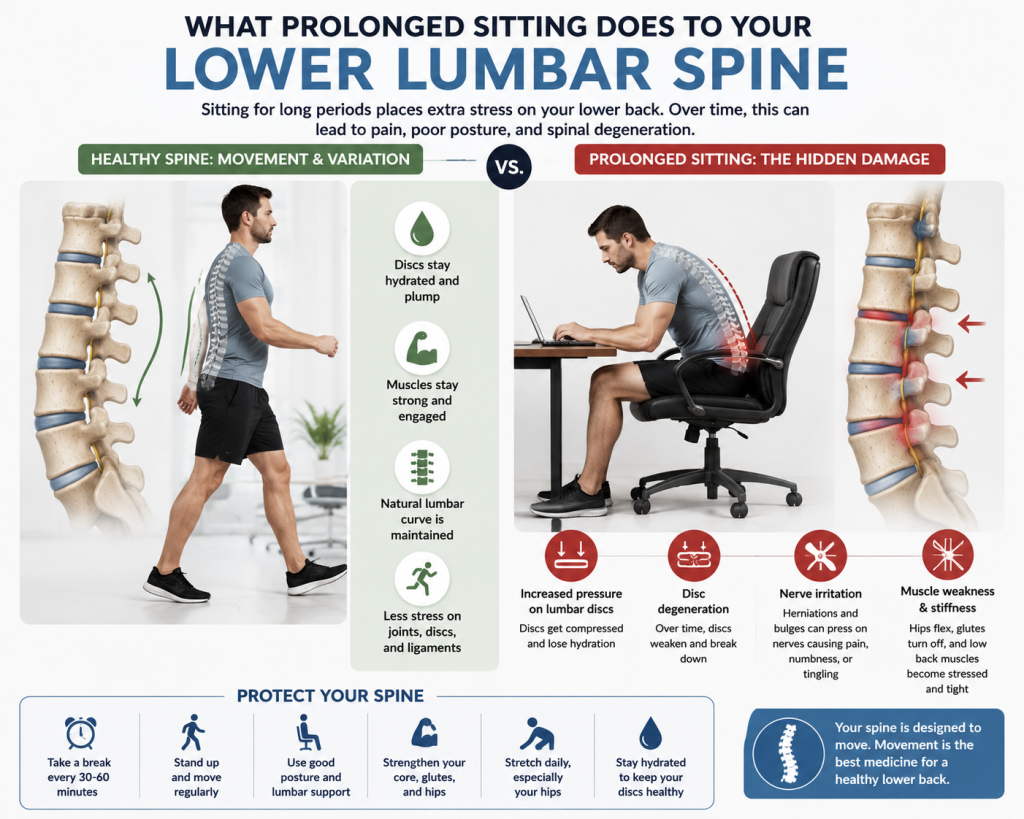
Many people don’t realize that sitting actually places more pressure on the discs in your lower back than standing. Statistically nearly double the pressure actually. So it would make sense that If you’re already dealing with a back injury or a complaint, such as a disc bulge or herniated disc, prolonged sitting can aggravate those symptoms by increasing stress on the injured area.
This is why many people notice their back feels worse after a long commute, a day at the office, or a cross-country flight. The good news is that you don’t have to quit your desk job.
A great starting point is breaking up long periods of sitting or inactivity. Stand up every 30 to 60 minutes—even if it’s only for a minute or two. Walk around the office, stretch your hips, or simply change positions. Other great recommendations are to make sure your chair supports your lower back, keep your feet flat on the floor, and position your computer monitor at above eye level so you’re not constantly leaning forward.
Away from the office, Regular exercise, core strengthening, and maintaining good mobility can also help your spine better tolerate the demands of daily life.
If your back pain lasts more than a couple of weeks, keeps coming back, or begins to travel into your leg with numbness or tingling, it’s time to get evaluated. Persistent pain isn’t something you should simply learn to live with. We often have conversations in our office about the difference between common and normal. Back pain is not normal, however it is extremely common. A thorough examination can help determine the underlying cause and identify the most appropriate treatment plan.
Remember, sitting itself isn’t the enemy—staying in one position for hours is.
Your body was built to move, and even small movement breaks throughout the day can make a big difference for your spine.