

What is Degenerative Disc Disease?
Have you ever had an X-ray or MRI and been told you have “degenerative disc disease”?
If those words sound scary, you’re not alone. Many people hear “degenerative” and immediately think their spine is falling apart.
But what does degenerative disc disease actually mean? Is it causing your pain? Can it be treated? And does it mean you’ll eventually need surgery?
In this post, we’re going to break down what degenerative disc disease is and what you can do to take care of your spine.
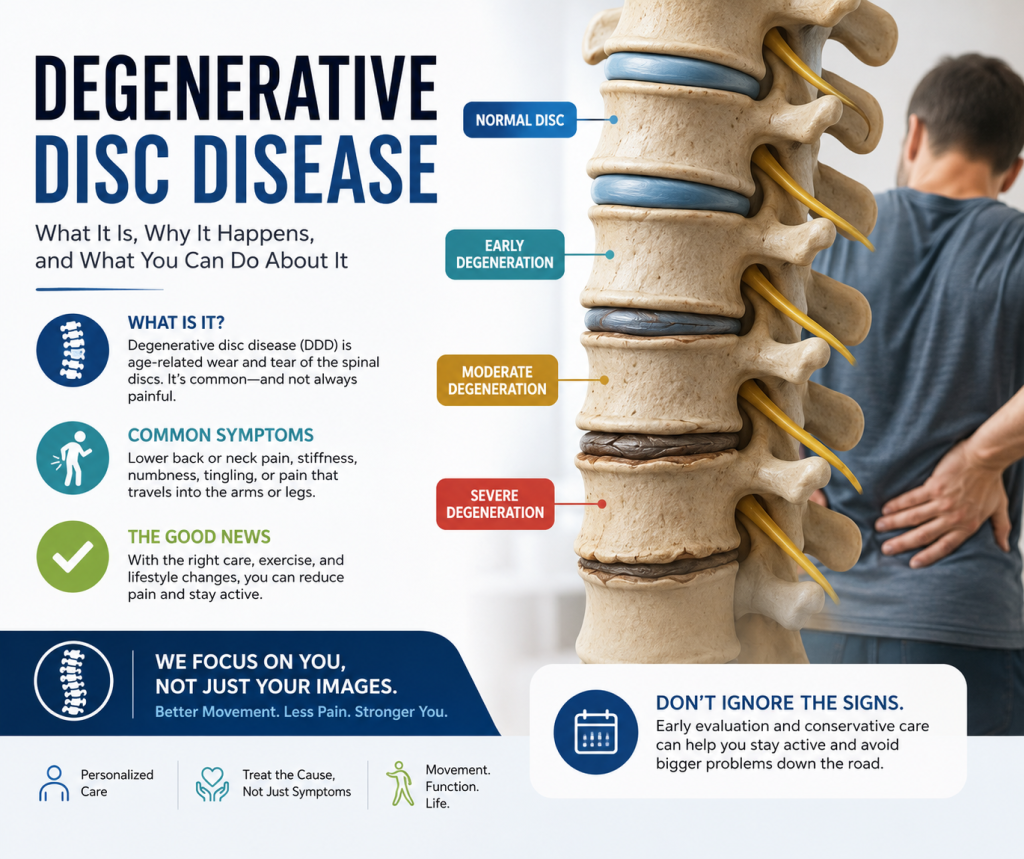
Let’s start with some anatomy…Between the bones of your spine are discs that act like cushions and help your spine move. As we get older, these discs naturally change. They can lose some of their water content, become less flexible, and gradually lose some of their ability to absorb stress. These age-related changes are commonly referred to as degenerative disc disease, or DDD. But here’s something important: despite the word “disease,” disc degeneration is often a normal part of aging. In fact, many people have degenerative changes on an X-ray or MRI and don’t have any pain at all.
So what causes it? Age is one of the factors, but it isn’t the only one. Your genetics, previous injuries, repetitive stress, posture, smoking, body weight, physical activity, and the demands you place on your spine all influence how your discs change over time.
Think about the discs like the tires on your car. The more miles you put on them, the more they can change. But how they’re maintained and how they’re used can be the key to how your discs degenerate or don’t degenerate over time.
So let’s walk through some common disc symptoms. Some people with degenerative discs have no symptoms whatsoever. Others may experience lower back or neck pain, stiffness, or discomfort that gets worse with certain activities. The reason for this is because pain is a nerve problem, not a disc problem. If the structures around a nerve begin to put pressure on a nerve then the body will send you a warning signal much like the lights on the dash of your car does when it has a problem. Discs due to their position in the spine are very close to the nerves and it is common for them to put pressure on the exiting nerve roots. If a nerve becomes irritated or compressed, you may experience symptoms such as pain, numbness, tingling, or weakness traveling into an arm or leg. In many cases degenerative changes occur alongside conditions such as disc bulges, herniated discs, arthritis, or spinal stenosis.
That’s why it’s important to look at the entire clinical picture—not just an imaging report. We don’t want to neglect a disc issue just because a person is not in that much pain.
Now, the good news is that seeing degeneration on an X-ray or MRI doesn’t mean you’re destined to live with chronic pain. For most people, conservative care can be very effective. This typically includes structurally supportive and restorative care such as chiropractic, strength and mobility exercises, maintaining a healthy body weight, staying physically active, improving posture and training movement patterns, avoiding prolonged periods of inactivity: just to name a few.
The goal isn’t necessarily to make your spine look young again on an X-ray. The goal is to help your body move better, to enable your nervous system to reduce symptoms, and ultimately to improve your quality of life.
If you’re experiencing persistent back or neck pain, recurring symptoms, numbness or tingling, or pain that travels into your arm or leg, it’s a good idea to get evaluated. And if you develop significant weakness, loss of bowel or bladder control, or numbness around the groin area, seek immediate medical attention.
So remember: degenerative disc disease doesn’t necessarily mean your spine is “wearing out,” and it doesn’t automatically mean you’re going to need surgery.
Spinal changes are a normal part of aging. What matters is understanding your individual condition and finding the right approach to keep you moving for the rest of your life