
What Happens to Your Spine as You Get Older? | Aging Explained
What Happens to Your Spine as You Get Older?
Getting older is a normal part of life, and your spine changes right along with the rest of your body.
You may have noticed that you don’t move quite as easily as you did when you were younger. Perhaps your back feels stiffer in the morning, your neck doesn’t turn as far, or certain activities leave you feeling more sore than they used to.
But does getting older automatically mean your spine is becoming unhealthy?
Not necessarily.
Your spine naturally undergoes changes throughout your lifetime. Some of these changes are simply part of normal aging and may never cause symptoms. In fact, degenerative changes on spinal imaging are extremely common in people who have no pain at all.
Understanding what happens to your spine as you age can help you make better decisions about movement, exercise, and maintaining your overall spinal health.
How Does Aging Affect Your Spine?
Your spine is made up of vertebrae, discs, joints, ligaments, and muscles that work together to provide stability and movement.
Over time, each of these structures can experience changes.
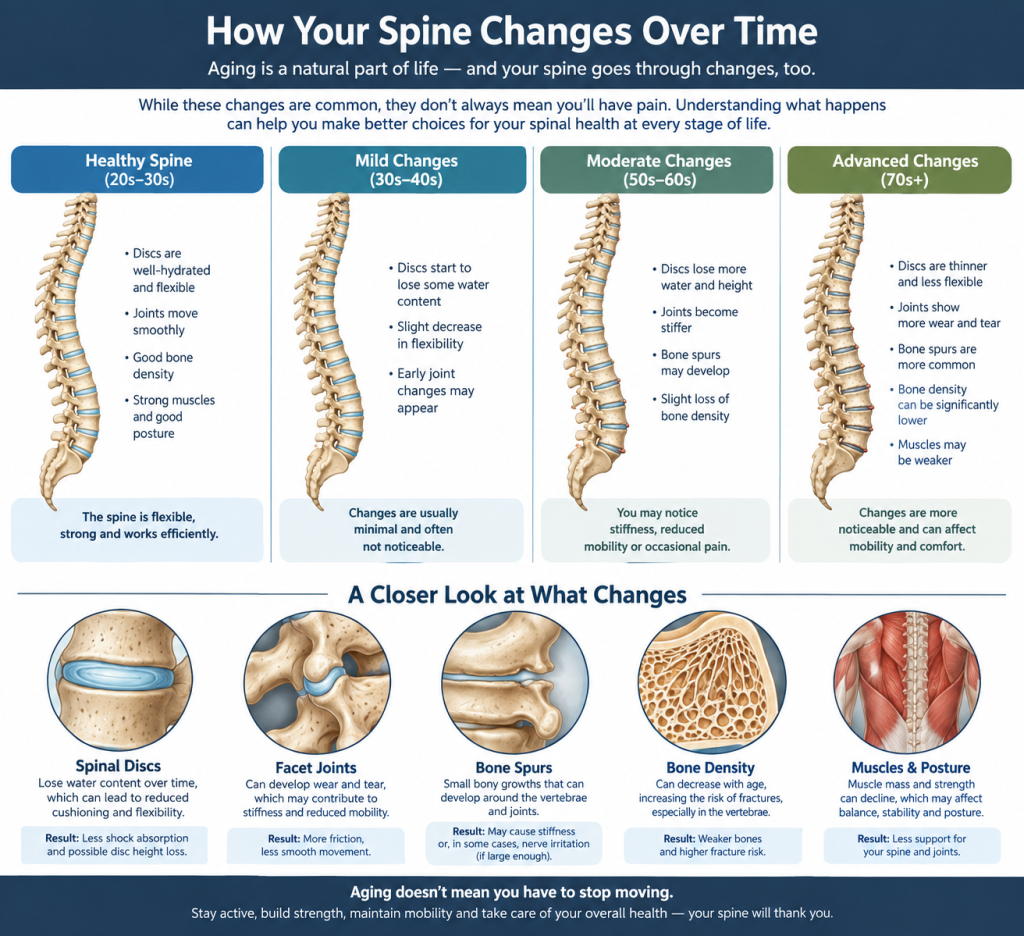
1. Your Spinal Discs Change
Between each vertebra is an intervertebral disc that helps cushion the spine and distribute forces.
As we age, discs can gradually lose water and change in their structure. This can contribute to changes in disc flexibility and, in some people, disc height.
These changes are commonly referred to as disc degeneration.
However, an important distinction is that disc degeneration seen on an X-ray or MRI does not automatically mean you have pain. Degenerative findings are common even in people who don’t have symptoms.
2. Your Spinal Joints May Become Stiffer
The small joints in the back of the spine, called facet joints, help guide and stabilize spinal movement.
Like other joints in the body, they can develop age-related degenerative changes. Cartilage can wear down, joint surfaces can change, and bone spurs may develop.
This can contribute to stiffness and reduced mobility.
3. Bone Spurs Can Develop
A bone spur, or osteophyte, is a small area of extra bone growth.
Bone spurs can develop around the vertebrae and spinal joints as part of degenerative changes. In some cases, they cause no symptoms at all. In other situations, larger bone spurs can contribute to narrowing around the spinal cord or nerves.
So seeing the words “bone spurs” on an imaging report doesn’t necessarily mean something is seriously wrong.
4. Your Bones Can Become Less Dense
Aging can also affect the bones themselves.
Bone density can decrease with age, increasing the risk of osteoporosis and fractures. The vertebrae are particularly important because weakened spinal bones can be susceptible to compression fractures.
This is one reason maintaining good bone health becomes increasingly important as we get older.
Weight-bearing activity and strength training can help support bone and muscle health.
5. You May Lose Muscle and Mobility
Your spine doesn’t work by itself.
The muscles surrounding your spine, hips, and core play an important role in helping you move and stabilize your body.
As we age, muscle mass and strength can decrease if we aren’t regularly challenging our bodies. Reduced strength and physical activity can contribute to decreased mobility and physical function.
The good news?
You can continue building strength and maintaining physical function as you age.
Does Spinal Degeneration Mean You’ll Have Back Pain?
This is one of the biggest misconceptions about aging and the spine.
You can have significant degenerative changes on an X-ray or MRI and experience little or no pain.
Conversely, someone can experience significant back or neck pain without having dramatic findings on an imaging study.
Research has found that degenerative disc changes, disc bulging, and facet joint changes are extremely common in adults over 60—even among people without symptoms.
That’s why your imaging shouldn’t be looked at in isolation.
A healthcare professional should consider your symptoms, physical examination, medical history, activity level, and imaging findings together.
Can You Slow Down the Aging of Your Spine?
You can’t stop the clock, but you can take steps to help your body remain strong and functional.
Stay Active
Regular physical activity is one of the best things you can do for your overall health as you age.
Walking, swimming, cycling, strength training, and other forms of exercise can help you maintain mobility and physical function. Older adults can benefit from a combination of aerobic, muscle-strengthening, and balance activities.
Build and Maintain Strength
Strength training can help maintain muscle mass and strength as you age.
Strong muscles help support movement, balance, and everyday activities.
Maintain Your Mobility
Don’t allow stiffness to become your new normal.
Regularly moving your spine, hips, shoulders, and other joints through comfortable ranges of motion can help you maintain mobility.
Take Care of Your Bones
Adequate nutrition and regular weight-bearing and strengthening activities are important components of maintaining bone health.
If you have been diagnosed with osteoporosis or have concerns about your bone density, talk with your healthcare provider about which activities are appropriate for you.
What About Chiropractic Care?
Chiropractic care may be one component of a comprehensive approach to maintaining movement and function.
A chiropractor can evaluate your spinal mobility, joint function, posture, and movement patterns and develop an individualized plan based on your needs and goals.
Depending on the individual, care may include spinal manipulation or mobilization, therapeutic exercises, stretching, strengthening, and recommendations for improving movement and daily habits.
However, not every type of treatment is appropriate for every person—especially when someone has significant osteoporosis, a fracture, neurological symptoms, or another underlying medical condition. A proper evaluation is important before beginning treatment.
The Bottom Line
Getting older doesn’t mean your spine has to stop working.
Your spine will naturally change throughout your lifetime. Discs can change, joints can become stiffer, bone spurs can develop, and bone density can decrease.
But aging and disability are not the same thing.
One of the best ways to support your spine as you age is to keep moving, maintain strength, work on mobility, and take care of your overall health.
And remember: an aging spine on an X-ray doesn’t automatically equal a painful spine.
If you’re experiencing persistent back or neck pain, stiffness, numbness, weakness, or difficulty staying active, consider having your condition evaluated by an appropriate healthcare professional.